The Best AI Customer Support Agents in 2026
Five platforms, one shared blind spot.

Summary: A bad chatbot interaction can undo an otherwise good customer experience in seconds. This compares five AI customer support agents, Salesforce Agentforce, Ada, Decagon, Sierra, and Lorikeet, on what each actually does well and where it’s a poor fit. All five share the same blind spot: none of them check whether the content behind their answers is still accurate.
Picture this: you just bought a subscription online, and now you can’t get into your account. Weird. You’ve now got two options: email support and wait it out, or poke the chat bubble that’s been flashing in your face since you landed on the site.
Say you go with the bot. Best case, it fixes the account thing itself, or points you in the right direction. Can’t do either? It loops in a human and tells you they’ll follow up. Fine, you move on with your day thinking that company’s got it together, and that your issue will be fixed.
Worst case, the same bot glitches, forces you back to the initial menu, and you’re no closer to logging in than when you started (we’ve all been there). And it’s not a small thing for the company: that one interaction essentially represents your overall customer experience with this company, and that negative interaction will probably shape your entire view on this company.
That’s the real stakes behind picking an AI customer support agent. It’s not a features checklist you’re looking at, rather it’s what stands between a good day and a bad one for every customer who faces it. Some of these agents just answer questions. Others read a request, decide what needs to happen, and go do it: checking an order, updating an account, handing you off to a person when it’s stuck.
What to look for in an AI customer support agent
At a minimum, a platform should:
Read from your existing content, connecting to a help center or CRM instead of requiring you to rebuild content somewhere else.
Escalate cleanly, recognizing when it’s out of its depth and handing off with full context instead of leaving the customer stuck.
Report what it actually did - like a resolution rate, and not just a count of conversations it touched.
The stronger platforms should also:
Take real actions, processing a refund or updating an account instead of only describing the steps.
Cover multiple channels from one system, chat, voice, and email handled by the same agent.
Learn from corrections, so a fix applied once carries forward instead of repeating.
The Top five AI Customer Support Agents
Salesforce Agentforce
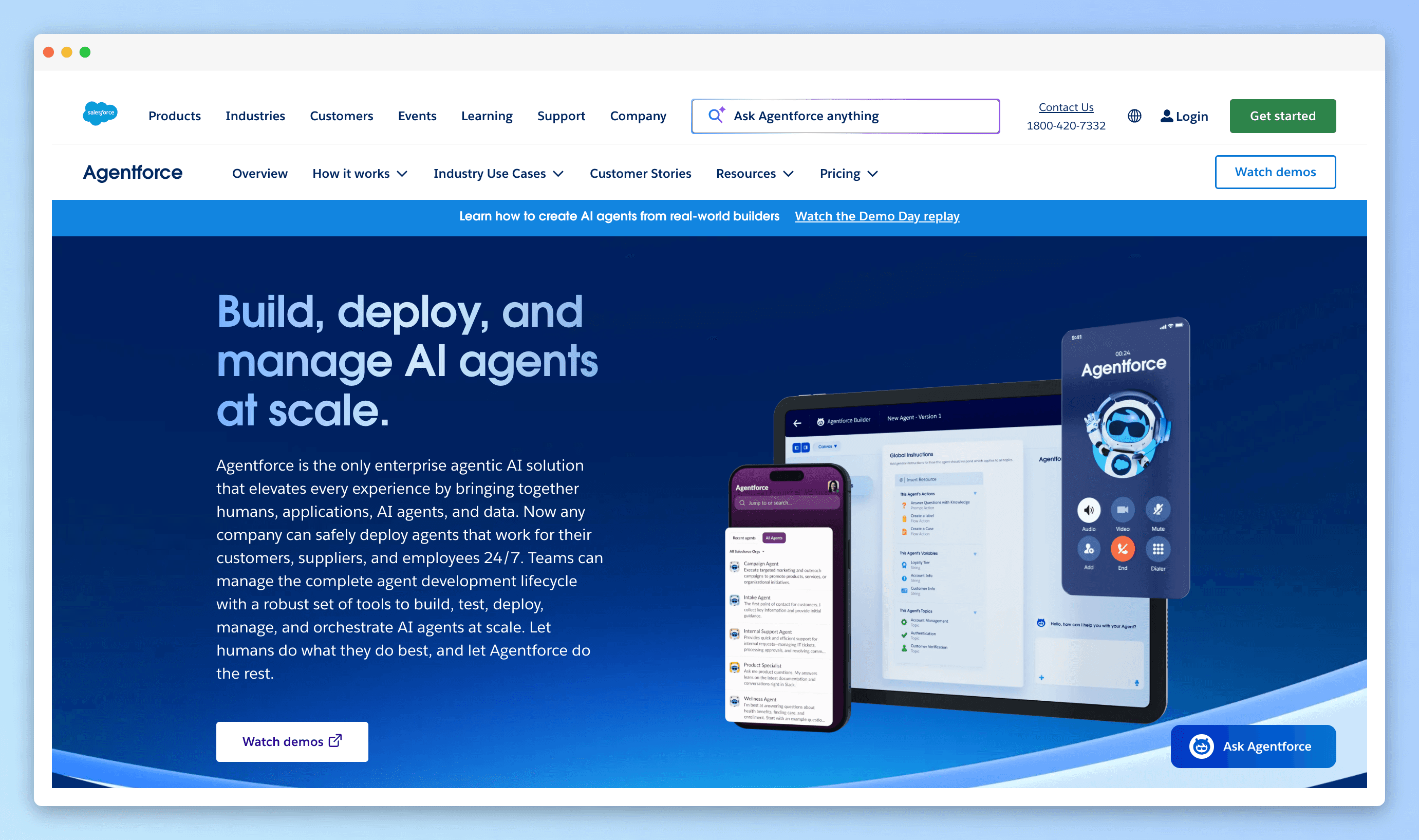
Salesforce’s own AI agent platform for service, sales, and more. Agentforce for Service pulls from a company’s help articles and CRM records together, and every request it sends to the underlying AI model passes through the Einstein Trust Layer first, Salesforce’s system for masking sensitive data before the model ever sees it.
Key features:
A reasoning layer that sorts each incoming request into a category, breaks it into steps, and runs the actions your team has already set up in Salesforce
Grounded in help articles, similar past cases, and live CRM data at once
Voice support with live transcription, and a human can take over mid-call
Pre-built templates for service, sales, and IT cut initial setup from months to weeks
How does it compare?
Agentforce’s real advantage is native access to CRM data most other platforms have to integrate with separately. The tradeoff is architectural: the agent’s actions build on a company’s existing Salesforce setup, so a lighter install means real build work before the agent does much. G2 reviewers consistently mention a steep learning curve during initial configuration. For teams already running Salesforce Service Cloud specifically, see what to add on top of it before reaching for a migration.
Why teams choose it
Teams already deep in Salesforce don’t need a separate CRM integration; the agent reads and acts on data they already have. It also grounds answers in both structured and unstructured sources at once, so help articles, CRM records, and case history all feed the same agent.
Best fit: teams where Salesforce already runs the business, with enough existing setup for the agent to plug into.
Weaker fit: teams on a lighter Salesforce install, or below Enterprise Edition, where the agent has little to build on.
Ada
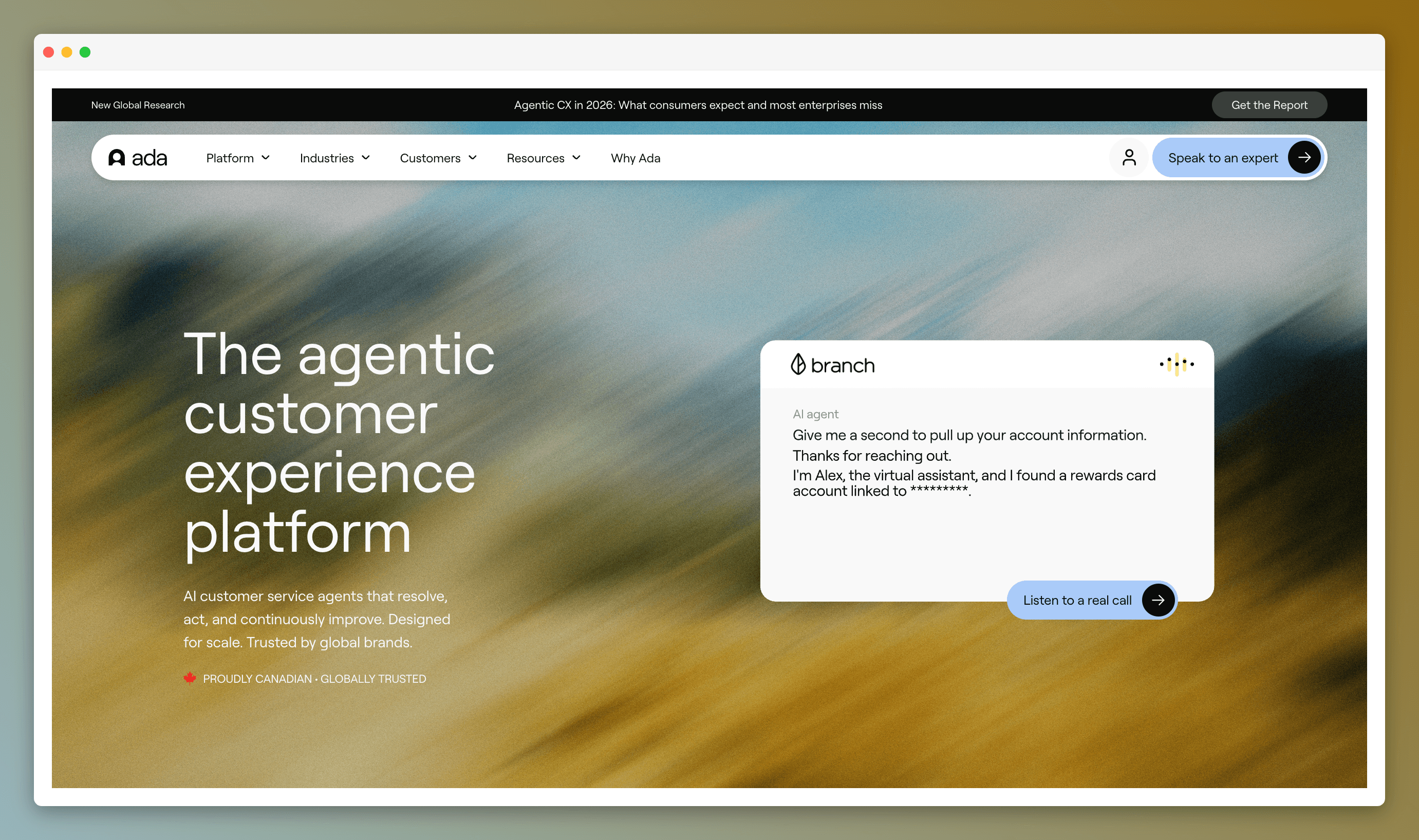
An AI agent that sits on top of an existing help desk, most often Zendesk or Salesforce, built for large support operations running high volume across channels.
Key features:
One agent across chat, voice, email, and social
Playbooks: multi-step workflows, like a refund with eligibility checks, that follow live data instead of a fixed script
Coaching applies a correction from one bad response to future conversations automatically
How does it compare?
Ada handles complicated, multi-step requests well across every channel at once. The limit is what it’s allowed to learn from: Ada’s own documentation says it reads formal help-center articles only, not past tickets, PDFs, wikis, or shared docs.
Why teams it
Ada handles complex requests, not just FAQs, because Playbooks follow real logic instead of breaking on the first off-script question. And one system covers every channel, so there’s no stitching together separate tools for chat versus voice versus email.
Best fit: teams with centralized, formal documentation and enough volume, 300,000-plus conversations a year by Ada’s own guidance, to justify enterprise pricing.
Weaker fit: teams whose real knowledge lives in tickets, wikis, or shared docs rather than published articles.
Decagon
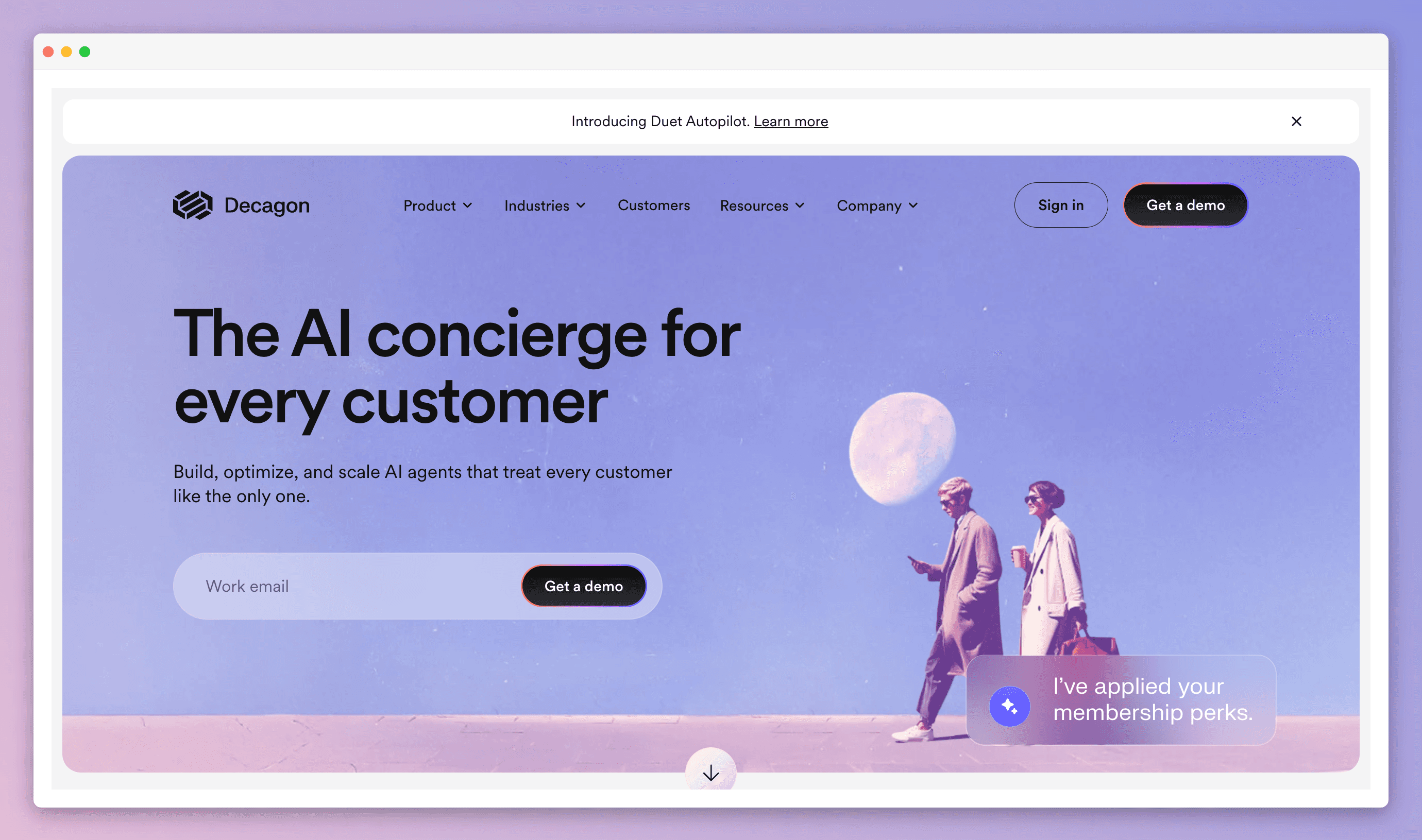
A fully managed AI agent built to finish a task, not just point to an article. A refund, a cancellation, a rebooking: the agent completes it.
Key features:
Takes actions end to end instead of stopping at an answer
Background monitoring watches agent behavior and flags anything drifting from expected patterns before it reaches a lot of customers
Lets non-technical staff write agent logic in plain English instead of a flowchart tool
How does it compare?
Decagon manages the agent for you rather than handing you the controls. That’s useful without a dedicated AI team on staff, and limiting if you want to see how the agent matches a question to a document, since that layer belongs entirely to Decagon.
Why teams choose it
It finishes the job. The design is built around completing an action, not just answering. Problems also get caught early, since the background monitoring flags drift before it turns into a wave of complaints, and support staff can adjust behavior themselves without needing an engineer.
Best fit: teams that want the agent operated for them.
Weaker fit: teams that want to inspect or tune retrieval themselves.
Sierra
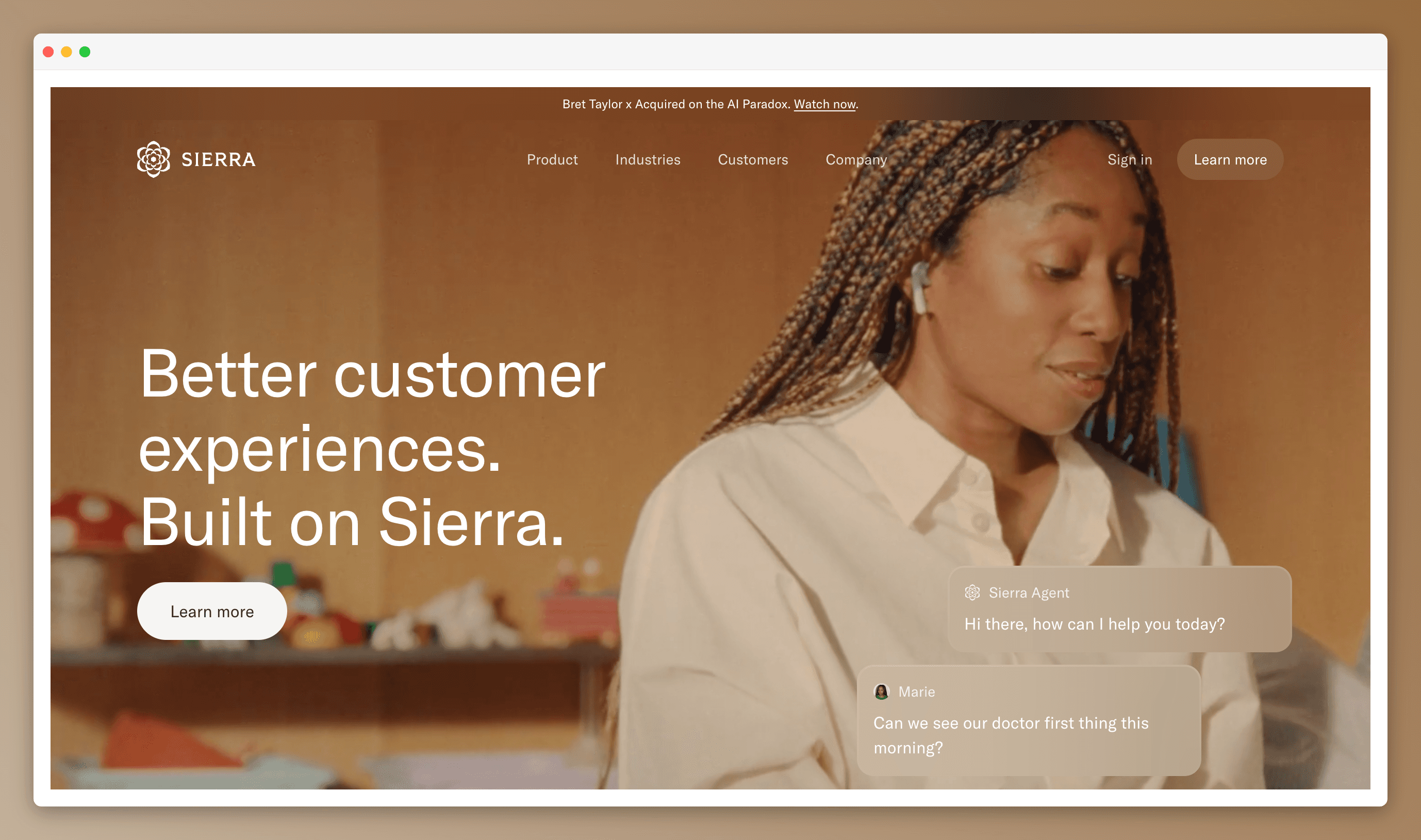
An agent built to go beyond first-line support into the rest of the customer lifecycle: processing a claim, walking through a refinance, handling a subscription change.
Key features:
A tool that builds a working agent setup from a plain-English description or an uploaded document, instead of a team building flows by hand
Draws on multiple AI models rather than one, so a single model having a bad day doesn’t take the system down
Priced on outcomes, a resolution, a saved cancellation, a completed upsell, rather than seats or usage
How does it compare?
Sierra is built to expand past support into sales and retention work. Outcome-based pricing sounds fair until you try to forecast a bill before launch, since the real number depends on outcomes the agent hasn’t generated yet.
Why teams choose it
The same agent handles retention or sales tasks, not just tickets, and the automatic setup tool cuts the manual work other platforms still require.
Best fit: teams that want AI handling more than support and can tolerate a variable bill.
Weaker fit: teams that need to know their AI spend in advance.
Lorikeet

An AI agent built specifically for complex, regulated support: fintech, healthtech, and similar industries where an answer depends on the state of an account, a transaction, or a compliance rule, not just a help article.
Key features:
Runs multi-step procedures the same way every time, so a refund with three required checks runs those three checks on every ticket
Connects to systems like Zendesk, Stripe, and internal APIs to take real actions
Covers chat, email, SMS, WhatsApp, and voice, with full context handed over on escalation
How does it compare?
Lorikeet’s rigid, procedure-first design is the opposite bet from a platform like Sierra that reasons more freely. That makes it strong where every resolution needs to follow the same compliant steps, and inflexible where support doesn’t need that level of structure.
Why teams choose it
It’s built for high-stakes, regulated support, where a wrong answer is a compliance problem, not just a bad review, and it follows defined procedures exactly rather than improvising something plausible-sounding.
Best fit: regulated or compliance-heavy support teams.
Weaker fit: teams that just need FAQ-level deflection.
Quick comparison
Platform | Who manages it | Best at | Weak point |
|---|---|---|---|
Salesforce Agentforce | Your team, inside Salesforce | Native CRM data and actions | Needs a mature Salesforce setup already in place |
Ada | Ada | Multi-step workflows, all channels | Only reads formal help-center docs |
Decagon | Decagon | Finishing the task, not just answering | No visibility into retrieval |
Sierra | Sierra | Work beyond support | Cost unknown until live |
Lorikeet | Lorikeet | Regulated, high-stakes workflows | Less suited to simple, low-stakes support |
The one thing none of them do
All five depend on the same thing: the content and systems they read from have to already be right. Ada’s own documentation says as much, plainly. The gap sits upstream of every agent here, before any of them ever see a conversation, and it’s rarely the bot that’s actually at fault. Pageloop covers that layer, connecting to the help center you already have and flagging what a release just made inaccurate.
Common questions
What is an AI customer support agent?
Software that reads a company’s existing content, help articles, CRM records, or past tickets, and uses it to answer questions or complete tasks like a refund or account update, with little to no human involvement in routine cases.
Do these AI agents replace a knowledge base, or read from one?
They read from one. Agentforce, Ada, Decagon, Sierra, and Lorikeet all ground their answers in existing content. Building that content, and keeping it accurate, is still a separate job.
What happens when the underlying knowledge base is outdated?
The agent answers anyway, with full confidence, from whatever it has. Ada’s documentation states this directly: answer quality tracks how current the connected content already is. Pageloop exists for this exact gap, watching a help center for what a release just made wrong so an agent is never working from a stale article in the first place.
Image Courtesy Art Institute of Chicago on Unsplash
High Street, Eton Date: c. 1845 Artist: George Pyne English, 1800-1884

Author
Fatema works across marketing and content at Pageloop. She has an academic background in Ecology, a side-life in fashion, and an irrational loyalty to milk coffee.
Other related content you might be interested in