Stop Blaming the Bot: How to Actually Fix AI Support Accuracy
Bad documentation was always costing you. AI just made the bill visible.

Support bots fail when the knowledge base behind them hasn’t been kept up to date. The reasons tend to be the same across teams: the product ships faster than anyone can document, nobody owns the docs as a full-time responsibility, and the maintenance gap was there long before the bot entered the picture. Fixing documentation takes either time or money, and most teams are short on both. Until the knowledge base is current, nothing else downstream will work.
One team we spoke to recently had a straightforward answer when we asked why they stopped using Fin.
They walked us through the math:
“Fin answers queries based on our [outdated] help center. With at least 50 questions a day, the cost of answering incorrectly added up fast.”
Head of support, SaaS company
Fin charges $0.99 per resolved conversation. With around 50 wrong answers a day, that adds up to roughly $50 in daily spend on resolutions that still needed a human to step in and correct. So they turned it off. They plan to bring it back once their documentation is in order, because routing everything to humans still costs more. Right now, the docs are the bottleneck.
The bot reads what you give it
Every AI support agent built on retrieval works the same way. It searches your knowledge base, pulls the most relevant article, and generates a response from what it finds. When it gets something wrong, something in that chain broke. In most cases, it’s the stale article to blame.
Intercom’s own team reviewed and updated more than 700 articles before enabling Fin on their own support channel. They divided the knowledge base by product area, gave teams a week to check each article, and retired anything that couldn’t be made current. Their reasoning was based on the fact that Fin’s accuracy is determined entirely by what it reads.
This team we spoke to had a version problem on top of their outdated docs. Their product has two versions in active use: a legacy version used by older customers and the current version still in development. Their documentation covers both, but imperfectly. When a customer asks a question, Fin pulls whichever article matches the query. When it matches the wrong version, it gives a confidently wrong answer about a flow the customer has never seen.
Three reasons the docs fall behind
Product velocity is the most visible one. This team shipped 20 major features over the past year and 15 in this quarter alone. This major shift in production speed changed their workflow significantly. With one new feature being released roughly every six days, each one can start touching something a customer might ask about.
But shipping pace rarely causes the problem on its own. Two other things typically compound it.
Most teams with deteriorating knowledge bases never had a dedicated person whose job it was to maintain them. Help content gets written by engineers or PMs around launch time, then left alone. No ongoing ownership or no review cycle, and no standard for what “complete” looks like. Articles accumulate, accurate on the day they were written and increasingly wrong after that.
Documentation also tends to sit below the line of what gets resourced. It has no revenue target attached to it, no sprint metric, and approving a hire to maintain it is a hard sell when the help centre already has content in it. Teams know the knowledge base needs work, but carving out time to do it consistently is a different problem.
The loop that keeps teams stuck
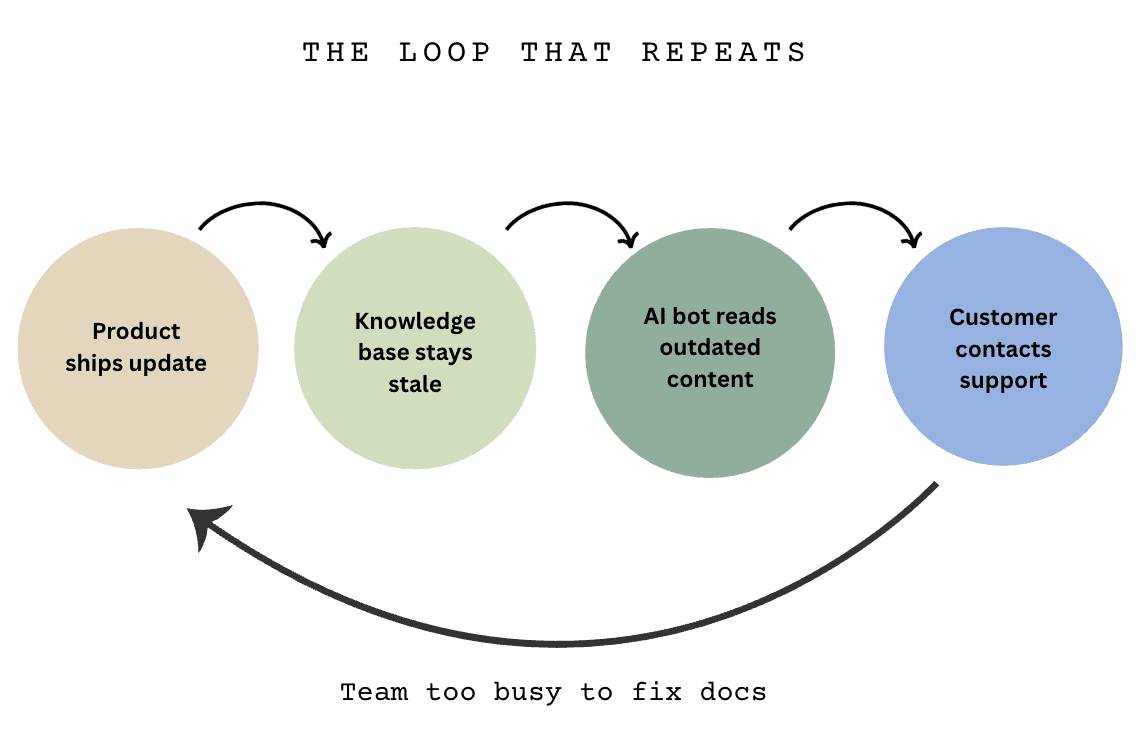
Auditing the existing content, retiring legacy articles, and rebuilding around the current product is what needs to happen. That requires time, and time is what a lean, fast-moving support team doesn’t have.
The next option teams typically consider is hiring. A technical writer experienced enough to run a documentation overhaul is a significant salary, and takes weeks to reach the point of producing anything useful. For a team where documentation was never seen as a revenue-generating function, that’s a hard investment to justify to leadership.
Without the time or budget to run a proper audit, the knowledge base stays behind. The team turns the bot off, and the support queue fills back up with the same questions it was supposed to deflect.
What adding AI actually did
Before the bot, a stale article was a passive problem. It only became a problem when a confused customer flagged it, and a support rep clarified the issue. Once AI started accessing these knowledge bases, it started to provide incorrect information pretty confidently. This is the behavior people call hallucination in support bots - the bots retrieve wrong information and present it as correct. Eventually customers slowly begin to lose their patience and contact support. Missed the point right? This is the opposite of what the bot was supposed to do.
Gartner’s 2024 Market Guide for Customer Service Knowledge Management Systems found that 100% of generative AI virtual customer assistant projects that lack integration to modern knowledge management systems will fail to meet their customer experience and cost-reduction goals. The bot is downstream of the knowledge base.
What makes this harder to fix over time is that AI is also accelerating the problem on the other side. Teams are now shipping faster partly because AI is helping their developers work faster. The documentation gap that existed before the bot is now growing at a rate that manual maintenance was never designed to keep up with.
What to do about it
85% of customer service leaders were exploring or piloting customer-facing conversational AI in 2025, according to Gartner. Most of them will hit the same wall this team hit. The bot goes live. The answers come back wrong. Someone checks the knowledge base and finds articles from eighteen months ago.
Pageloop sits in the gap between “the bot is live” and “the docs are current.” It monitors what changes in your product, identifies which articles are now outdated, and drafts the updates for your team to review before anything goes live. No migration, no new platform. It works on top of whatever you already have.
If you’re not ready to bring in a tool yet, start with the foundation. Our guide to writing support documentation covers how AI actually reads your knowledge base, why most documentation breaks at the retrieval stage, and what to change in your content structure so the bot can use it accurately.
The bot can wait. The docs can’t.
Image Courtesy Art Institute Chicago
Cliff Walk at Pourville, Claude Monet (French, 1840–1926)

Author
Fatema works across marketing and content at Pageloop. She has an academic background in Ecology, a side-life in fashion, and an irrational loyalty to milk coffee.
Other related content you might be interested in


