How Everstage went from end-of-quarter doc backlogs to day-one documentation with Pageloop

Pageloop features used: Article creation, Update detection, Chrome extension, Freshdesk integration
Everstage is a sales compensation platform used by companies like Chargebee, Postman, and HackerRank to automate commissions, quoting, and revenue planning. Founded in 2020, it serves mid-market and enterprise teams across SaaS, financial services, and insurance. Its product line is growing rapidly: the core commissions product plus two newer products, each shipping at its own pace.
Documentation at Everstage sits with the product marketing team: four people who own the knowledge base, in addition to their core responsibilities as PMMs. Sales compensation is a domain where a single workflow spans commission plans, quotas, and payout calculations, so writing about the product means genuinely understanding it. That makes the product marketers the natural owners but also makes every article expensive to produce.
A couple of days per release
Before Pageloop, every release went through the same pipeline.
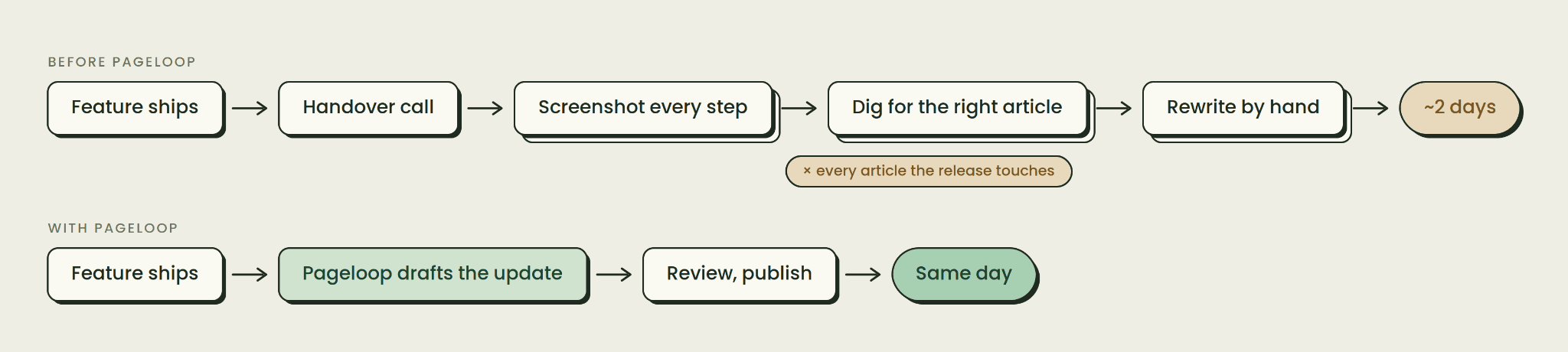
Each product marketer is paired with a product manager. When a feature ships, the product manager hands over the internal write-ups and walks them through the change on a call. Then the marketer logs into Everstage, clicks through the feature step by step, captures screenshots, and writes it up. Updating the knowledge base for a single release took at least a couple of days.
Most Everstage releases improve features that already exist, so a release usually involves updating existing articles rather than writing new ones. That was where most of the time in those two days went.
“Honestly, the real work was figuring out where the update actually belonged.
– Swetha, Associate Product Marketing Manager, Everstage
For every release, someone had to go through the knowledge base and find the exact article the update touched. Then came the finer judgement: which parts of that article change, and which stay. They would open the existing piece, follow the documented steps one by one, and carefully rewrite a single section without disturbing everything around it. On top of that, every visual change meant re-capturing screenshots by hand in each article that showed it.
The knowledge base itself made the searching harder. Articles were broken up too finely and inconsistently formatted, and outdated content only surfaced during a manual review every six months, so an article could stay wrong for a long time before anyone noticed.
As shipping sped up, the whole process started taking more and more of the team’s time. Documentation for new features was regularly pushed to the end of the quarter, long after the features were released.
Claude was already in the workflow
Everstage had already been experimenting with Claude to help with their documentation workflow. While it handled drafting capably, it could not remember the product. Every single update meant rebuilding the context from scratch: explaining what had shipped, walking through the changed workflow, describing why it mattered, all before a word of documentation could be written. A large chunk of the effort went into briefing Claude rather than producing the article.
Updating an existing article was beyond Claude altogether. It had no visibility into Everstage’s knowledge base, so the team still had to find the right articles and apply the change by hand for every release, for every article.
“AI helped with writing, but the heavier lifting of context and article maintenance stayed a manual job.”
– Swetha, Associate Product Marketing Manager, Everstage
Finding the right article is now Pageloop’s job
Pageloop removed the briefing step entirely. The team records the feature or workflow once using the Chrome extension, clicking through the product interface while Pageloop captures the steps and screenshots, and that recording serves as the brief. Nothing needs to be typed out and explained separately, and the repetitive back-and-forth that used to precede every article is gone.
“Recording the feature or workflow once is now enough, since Pageloop picks up the context directly from that recording.”
– Swetha, Associate Product Marketing Manager, Everstage
The maintenance side runs on Update detection. When a release lands, a marketer records the change just as they would for a new article, or pastes in the release notes, and Pageloop takes it from there: it scans the whole knowledge base, finds every article the release touches, and suggests text and screenshot replacements. The team reviews and approves rather than searches and rewrites. The hunt for where an update belongs, the part Swetha called the “real work“, is now Pageloop’s job.
Articles move straight from Pageloop into Freshdesk, with no separate login and no manual push. The team also formats articles in Pageloop’s editor before publishing, which gets around the limited formatting options in Freshdesk’s own editor.
Articles now go live alongside releases
Between June and August 2026, Everstage published 24 new articles through Pageloop and updated 14 existing ones. The update runs surfaced over 230 suggested changes, and of everything the team has reviewed, 99% was accepted. Nearly half of the accepted changes were screenshot replacements, the update work the team used to do by hand, one article at a time.
The change that matters most is timing. New features are now going out with their documentation on day one, where they previously joined an end-of-quarter backlog. The six-month review is no longer what catches outdated content, because updates happen when releases do.
“Pageloop has meaningfully cut down the time spent per release and kept the knowledge base far more current than the old process ever allowed.”
– Swetha, Associate Product Marketing Manager, Everstage